- DCIST's Newsletter
- Posts
- Door County Invasive Species Team Newsletter
Door County Invasive Species Team Newsletter
January/February 2026

DCIST Coordinator
January 07, 2026
Table of Contents
The 2026 Field Season is on its way!
Looking forward to the 2026 season, DCIST will continue with its priority invasive species monitoring and control efforts throughout Door County. Our priority invasive species are non-native Phragmites, teasel, knotweed, wild parsnip, and purple loosestrife. We will also be continuing with our efforts for European frog-bit and black swallow-wort.
Additionally, DCIST will be holding educational workshops and hands-on work events for homeowners to gain more knowledge and experience with the control of terrestrial invasive species. As events are scheduled they will be announced via newsletters, social media, and DCIST’s website. So follow us on Facebook, Instagram, and doorinvasives.org to stay up to date on these events.
DCIST will continue to participate in the state wide Clean Boats Clean Water efforts focusing on the Sawyer Park and Sunset Park boat launches. These efforts include having inspectors at these boat launches to engage with boaters about the steps they need to take to prevent the spread of invasive species.
Native Species Highlights
Winter Bird Buffet
When winter winds blow and food gets scarce, native plants step up as nature's pantry for backyard birds. Berries that cling through snowstorms, seed heads swaying in icy breezes, and fruit clusters waiting for freeze-thaw softening provide life-saving nutrition for cardinals, finches, bluebirds, and sparrows. These plants not only sustain wildlife when feeders fall short but also add striking color, texture, and movement to snow-covered gardens. Choose natives that hold their bounty through winter, and your yard becomes a year-round haven for feathered friends.
Winterberry (Ilex verticillata): is a deciduous holly native to wet areas, thickets, and woodland edges. In summer it’s a modest-looking shrub, but once the leaves drop, brilliant red berries cling tightly to the stems and light up the winter landscape. These berries are an important cold-season food source for songbirds, especially after snow covers other natural food. Winterberry prefers moist, acidic soils and full sun to part shade, making it a great choice for rain gardens, low spots, or as a winter focal point in the yard.
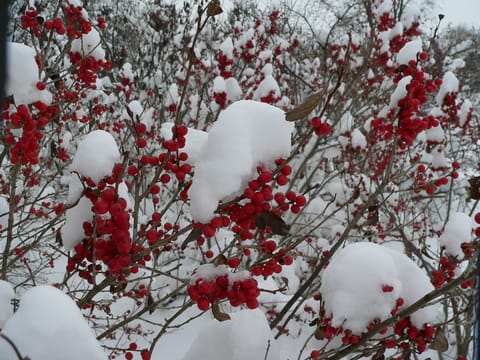
Photo: University of Minnesota Extension
Black chokeberry (Aronia melanocarpa): is a multi-season shrub valued for its spring flowers, glossy summer foliage, and long-lasting dark purple fruits. Clusters of white blossoms in spring give way to berries that often persist into winter, providing nutritious food for birds when other resources have faded. The leaves turn shades of red and orange in fall, adding extra ornamental appeal. Black chokeberry tolerates a wide range of soils and does well in full sun to part shade, making it a resilient option for hedges, mass plantings, or mixed borders.

Photo: Alan Bergo
American cranberrybush viburnum (Viburnum opulus var. americanum): is a versatile native shrub known for its showy white flower clusters in spring and bright red berry-like drupes that hang on well into winter. These fruits are often left alone until they’ve been softened by freeze–thaw cycles, then become valuable late-season food for many bird species. The lobed leaves turn attractive shades of red and purple in fall, providing another season of interest. This viburnum thrives in full sun to part shade and moist, well-drained soils, and works well as a hedge, screen, or specimen shrub in wildlife-friendly landscapes.
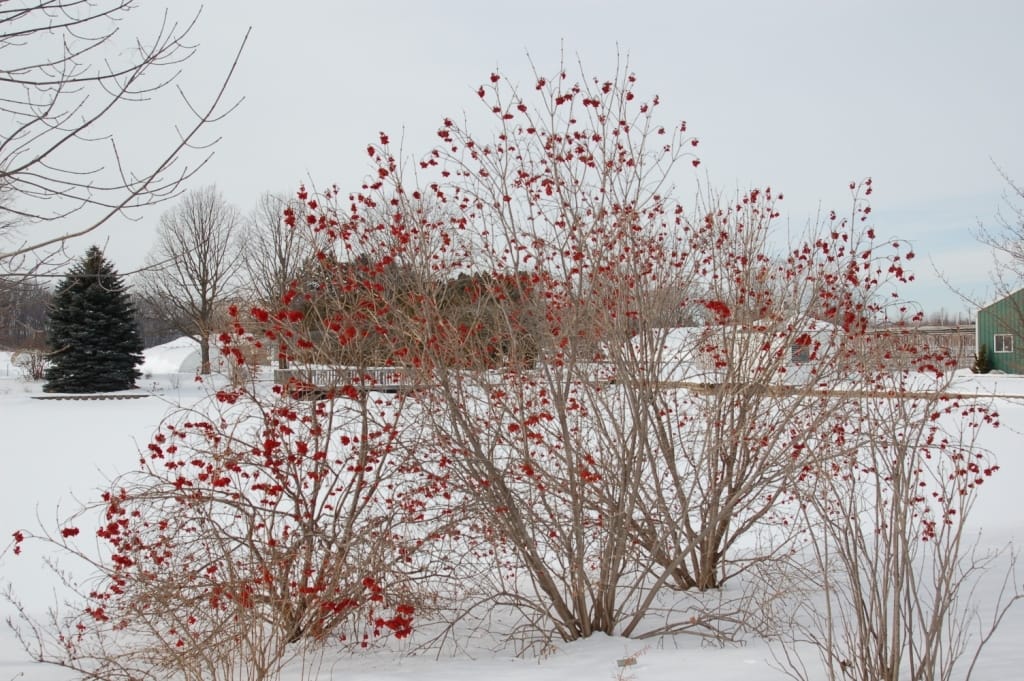
Photo: Plants Nouveau
Staghorn sumac (Rhus typhina): is a striking shrub or small tree easily recognized by its fuzzy, antler-like branches and bold, pinnate leaves. In late summer, it produces dense, upright clusters of red fruits that persist through winter like natural bird feeders. These fruits are especially important as an emergency food source for birds later in the season when other options are depleted. Staghorn sumac prefers full sun and well-drained soils and is highly tolerant of poor, dry, or disturbed sites, making it useful for tough slopes, naturalized areas, and restoration plantings.

Photo: Chumlee10
Workshops and Volunteer Opportunities
Terrestrial Invasive Workshop
On January 21, DCIST will host the first of five workshops funded through our Wisconsin Coastal Management Program grant, kicking off a series focused on terrestrial invasive species with an in-depth look at woody invaders. Each workshop in this series will highlight a different aspect of terrestrial invasive species management, but this first session will concentrate on identifying common woody invasive plants and exploring effective control options to help you plan your management work for the coming season.
Space is limited for each workshop. You can register here or by emailing DCIST Coordinator at [email protected].
Date: January 21, 2026
Time: 11:00am - 2:00pm
Location: Crossroads at Big Creek
Fish Tales: Where the Suckers Swim

Join us for an engaging talk as Dr. Karen Murchie explores the fascinating journey of white suckers in Green Bay. Learn how acoustic tagging during spawning season reveals their post-spawning distribution throughout the bay.
Presented by Dr. Karen Murchie
Director of Freshwater Research, Shedd Aquarium
Free & Open to the Public
Date: January 22
Time: 7:00pm - 9:00pm
In-Person: Crossroads at Big Creek
Online: Zoom or Facebook Live
Visit doorcountylibrary.org/event on the day of the talk to access the livestream links. Don’t miss this opportunity to dive into freshwater research and fish migration science!
Winter Sanctuary Guided Hikes
Join a naturalist for an exploration of The Ridges Sanctuary in the winter. We’ll head out on the trails to learn about the history of The Ridges, explore some winter adaptations, search for animal tracks, and more! If conditions allow, we will utilize snowshoes for our hike. Snowshoes are available to rent from the Nature Store for $5 per pair. Suitable for all ages.
Fee: $10 | Members receive 20% Discount | Snowshoe rentals available for $5 per pair.
Dates and times are various throughout the winter months. Find dates and register here: Events
Walk & Talk with Ridges Research Team
Join Applied Research Ecologist, Victoria Holderer and Director of Research, Tony Kiszonas, on an educational hike highlighting different focuses of research at The Ridges. We will take a stroll down Hidden Brook Boardwalk to discuss ongoing research initiatives, including research for restoration work with the Dwarf Like Iris, Orchid Restoration Project, and the Boreal Climate Survivability Project, along with other initiatives we are partnering on. Suitable for ages 18 & up.
Dates: January 19th and February 16th
Time: 1:00pm - 2:00pm both dates
Location: Cook-Albert Fuller Nature Center
Jobs
Do you enjoy working outdoors and want to make a difference for Door County’s natural areas? Local conservation organizations are hiring people to help protect natural areas, combat invasive species, and support habitat restoration. Explore the current openings below and see how you can turn your passion for the outdoors into meaningful work.
Current openings at the Door County Land Trust
Environmental Stewardship and Outreach Intern with Crossroads at Big Creek
Employment with The Ridges Sanctuary
Conferences
Wisconsin Salt Week
Now that we’re deep into winter and roads and sidewalks are turning icy, salt becomes our trusty sidekick for safe travel. But like any good tool, salt works best in moderation—excess use can harm freshwater ecosystems, drinking water, and soil health. Wisconsin Salt Week (January 26-30, 2026) is here to help us use it wisely!
This national awareness campaign features livestreamed webinars, local events, and success stories from contractors and municipalities that have slashed salt use by 30% or more while keeping everyone safe.
Learn more and find events at wintersaltweek.org. Join the effort to keep Wisconsin waters fresh!

Wisconsin Science Conference
Join the Wisconsin Wetlands Association for their annual Wetland Science Conference happening in Baraboo/Wisconsin Dells February 24-26, 2026. This year’s theme, Wetlands: Going Beneath the Surface, invites us to look deeper—scientifically, relationally, and historically. As scientists, practitioners, land managers, students, and community leaders, we know that understanding and caring for wetlands requires more than surface knowledge. It asks us to dig into the processes, data, and stories that reveal how wetlands function and why they matter to land and water, wildlife and people. Learn more about the conference and register here: Wisconsin Science Conference
The Prairie Enthusiasts
Join The Prairie Enthusiasts for their annual virtual conference happening February 18-20, 2026. This conference brings together people of various prairie and savanna knowledge-levels. Whether you have deep roots in prairie restoration or your passion for these habitats has just begun to bloom, there’s a place for you to learn with our community. Learn more about the conference and register here: Biodiversity from the Ground Up
Wisconsin Lakes and Rivers Convention
When tackling a monumental challenge, it sometimes takes a long time to see results. The 2026 Lakes and Rivers Partnership Convention will look back on the long-term programs and the accumulated actions of countless people that have persevered through many decades. Their dedication has ensured that the programs that developed in the 70’s, 80’s and 90’s are still with us in the 2020’s and beyond. We will also celebrate the people who will continue to carry the torch for water protection and restoration into the future.
This years conference is happening April 15 - 17, 2026 in Stevens Point, WI. Learn more about the conference and register here: Decades of Dedication
Invasive Species Forum
The virtual Invasive Species Forum is an annual event that brings attention to invasive species issues, research, and advances in prevention and management occurring across North America and beyond. The 2026 Invasive Species Forum will take place from February 17 - 19, 2026. Learn more about this event and register here: Progress Through Partnerships
Invasive Species News
Tech Tracks Invasive Shrubs: Purdue’s New Tool
Purdue researchers have developed an innovative remote sensing method to detect invasive shrub species like buckthorn and bush honeysuckle across large areas, such as the Chicago region.
The breakthrough combines satellite imagery—which identifies excessive greenness from early leaf-out and late fall retention—with lidar data to map dense shrub canopies. In the Chicago area, over 75% of forests showed invasive species presence, comprising more than a third of trees.
This technology helps overcome labor-intensive ground surveys, enabling efficient landscape-scale management. An online tool and workshops make the data accessible to forest managers and community members for targeted eradication.
Protecting native forests like oak woodlands—vital for wildlife—has never been easier with tools like these!
Oak Wilt: Prune Smart This Winter
Oak wilt is a deadly fungal disease that affects oak trees across Wisconsin, killing red oaks rapidly and weakening white oaks over time. While oak wilt has not been documented in Door County, it is present in many other parts of the state and can spread through root grafts or sap-feeding beetles that carry the fungus from infected trees to fresh wounds.
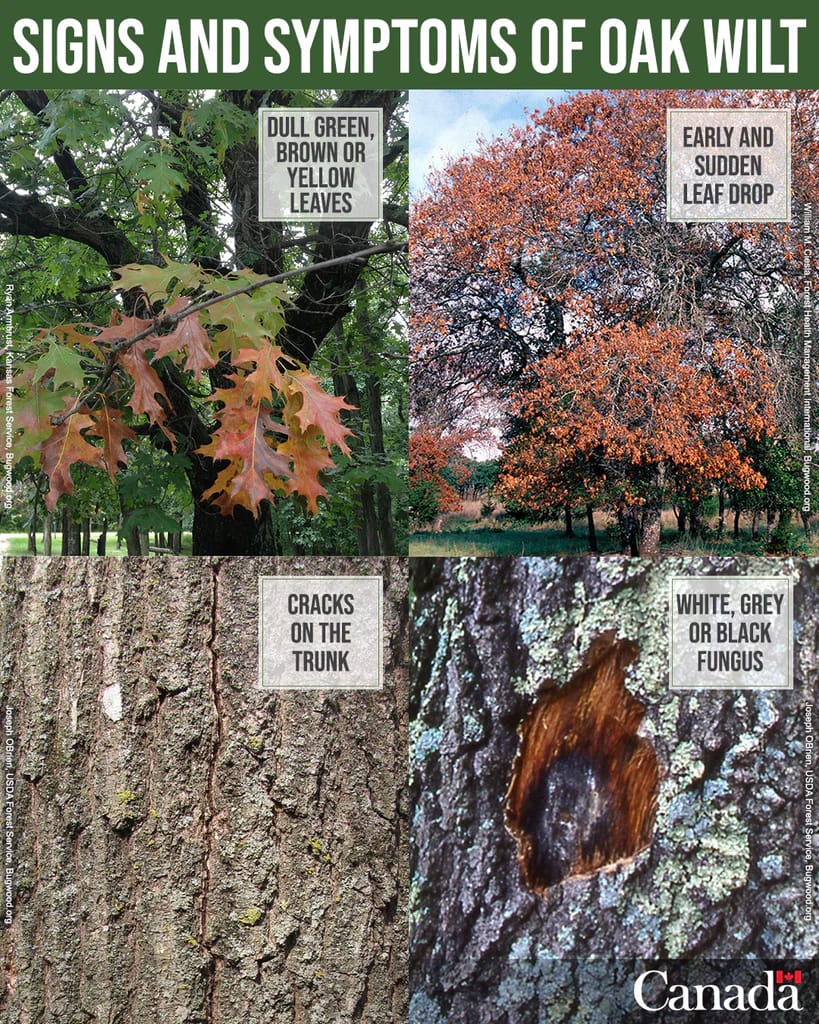
Photo: Canadian Food Inspection Agency
Winter is the safest time to prune oak trees, as beetles are inactive and trees are dormant, preventing infection through pruning cuts. Avoid pruning oaks from April through July when risk is highest—sap-feeding beetles are active and attracted to fresh wounds. If emergency pruning is needed during growing season, immediately paint all cuts with latex or tree wound paint.
For more information on oak wilt prevention, visit the Wisconsin DNR oak wilt page:
https://dnr.wisconsin.gov/topic/Foresthealth/oakwilt
Big Win for Great Lakes Fisheries
The U.S. House of Representatives passed the bipartisan Great Lakes Fisheries Research Reauthorization Act on December 15, 2025, following unanimous Senate approval. This legislation reauthorizes $15 million annually through FY 2030 for the U.S. Geological Survey's (USGS) Great Lakes Science Center, which expired in September 2025. The center conducts vital research on fish populations, invasive species, habitat health, and water quality that supports the $5.5 billion Great Lakes fishery—critical for commercial fishers, recreational anglers, and coastal communities.
Key activities include:
Monitoring sea lamprey populations and chemical control programs.
Studying invasive species impacts and native fish restoration.
Assessing contaminants, water quality, and ecosystem health.
“Millions of Ohioans rely on—and enjoy—the bounty of fishing... A healthy lake is essential,” said Sen. Husted. Sen. Peters added, “This bill ensures critical research continues to protect our invaluable freshwater fisheries.”
This victory underscores ongoing bipartisan commitment to the Great Lakes, building on prior efforts like the 2019 authorization.
You can read the whole article here: Great Lakes fisheries research
A Cross-Board Victory Against Invasive Mussels
In August 2025, a major win occurred in the fight against aquatic invasives: watercraft inspectors from Alberta, Alaska, and the U.S. Fish and Wildlife Service successfully stopped a mussel-fouled boat from New York from potentially introducing Dreissena mussels (zebra and quagga) to Alaska’s pristine waters.
This collaborative effort highlights the critical importance of early detection—inspectors at Alberta’s Vermillion WID station spotted mussels on the boat’s hull and motor, decontaminated it, sealed it, and alerted partners at the Alaska border. The cooperative boat owner helped ensure the vessel was thoroughly cleaned before clearance.
Dreissena mussels are devastating invaders that clog infrastructure, outcompete natives, and cost billions annually. Preventing their spread to new areas like Alaska relies on vigilance and the simple Clean Boats Clean Waters practices:
CLEAN off all plants, animals, mud, and debris before leaving the waterbody.
DRAIN all water from watercraft, live wells, motors, and equipment.
DRY everything in the sun for at least 5 days (or wipe with towels) before entering a new waterbody.
This victory shows how everyday actions and cross-border teamwork keep our waters protected!
Invasive Species Highlight
Multiflora Rose: The Thorny Invader
Multiflora rose (Rosa multiflora) is an invasive shrub that invades open woodlands, roadsides, savannas, and prairies. Primarily found in southern Wisconsin, it has been identified in northern counties including Door County. It forms dense, impenetrable thickets that exclude native species and produces up to 500,000 viable seeds per year (viable 10-20 years).

Photo: Peter M. Dziuk
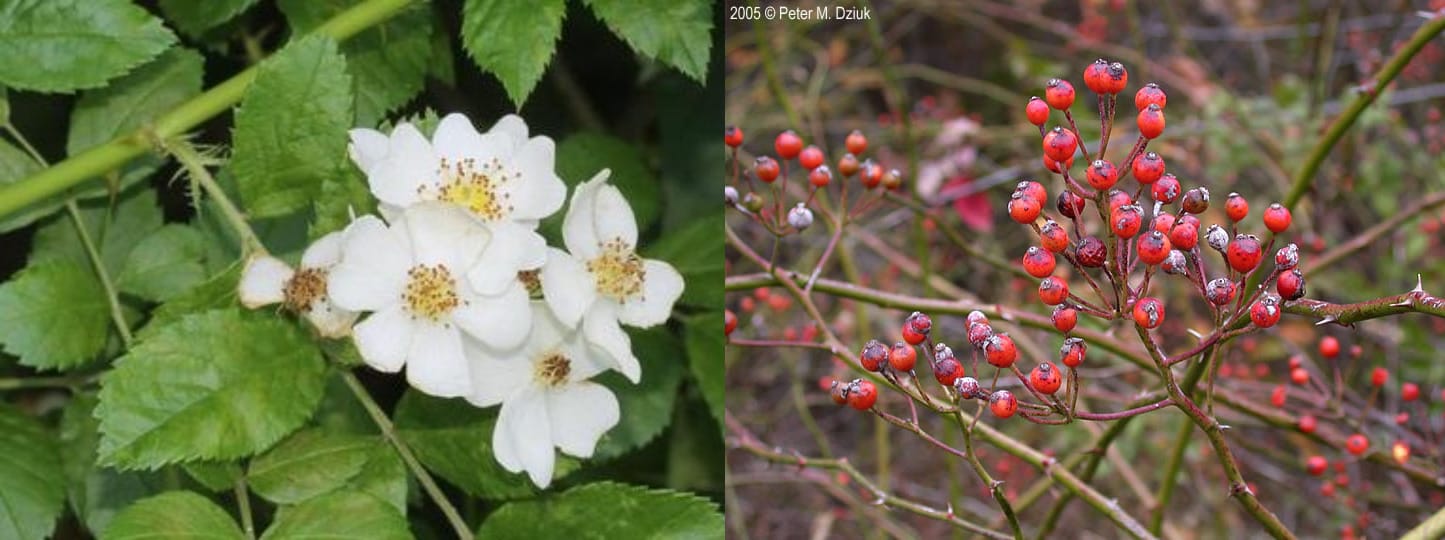
Although it won’t have leaves during the winter months. There are still a few features that make this shrub identifiable. It has brown to reddish-brown branches with stiff, curved, sharp thorns. Thickets reach 10-15' tall, 9-13' wide, spreading wider than tall. Small (1/4"), bright red hips persist through winter, spread by birds. Distinguished from native roses by large, recurved thorns.
During the warmer months, it has alternate leaves with 5-11 small, sharply-toothed oval leaflets. There are fringed stipules at leaf base. And fragrant white-to-pink flowers in mid-late spring.
Photos: Rob Routledge (left); Peter M. Dziuk (right)
Multiflora rose spreads primarily by bird-dispersed seeds and root sprouting, thriving in full sun to partial shade across a wide range of soils. Control is challenging but essential—small plants can be dug out, while larger stems require cutting and stump treatment with herbicide. In Wisconsin, it is a Restricted species under NR 40.
For more information and control recommendations, visit:
https://dnr.wisconsin.gov/topic/Invasives/fact/MultifloraRose
Get Involved
DCIST relies on volunteers to help collect data on where invasive plants and animals are found in Door County. If you’re interested in helping, DCIST can provide training on the use of handheld GPS units or you can also use the GLEDN app to report findings via your smartphone. Contact DCIST at [email protected] for more information or learn how to download and use the app at https://fyi.uwex.edu/wifdn/. Keep an eye out for our next newsletter and keep up to date on our DCIST website at https://doorinvasives.org. We will be posting any and all additional training opportunities & educational materials as we receive them.
Stay in touch!
The Door County Invasive Species Team – Jason Miller, Coordinator
DCIST Message Line: 920-746-5955
Email: [email protected]
Check out our website at https://doorinvasives.org